

TIPS FOR TONIGHT
Adventures in Sleeplessness - stories from sleep-coached dads

Dads often suffer as much as moms when their baby or toddler isn't sleeping.
Moms definitely feel the brunt of post-partum sleep deprivation – those newborn months are a blissful slog. But (thankfully) modern dads are often very involved in soothing their restless little ones, especially as they get a little older, and they too pay the price of sleepless nights. Here are a few of their stories about getting to the other side of sleeplessness:
Zac
Ok.
Some parents have good sleepers. You ask them how they do it and they tell you that they just put their kid to bed and they sleep. They look at you like it's a silly question.
It was honestly pretty hard not to resent parents like that because we didn't have one of those kids.
By the time our daughter was two, Melanie and I had developed a lengthy, complicated and totally useless bedtime routine. It was a combination of nursing, dancing, singing, voodoo, stories, more dancing, patting, loveys, no not those loveys, new ones, not those ones, the other one ("it's in the car. It's in the car!"), bouncing in fifteen different ways, bouncing while patting and dancing and singing, high humming, low humming, and finally like another hour of nursing. Every night our ritual seemed to get longer. Wake ups were still happening two to five times a night, quenched only by more nursing and the kind of bed sharing that wasn't good for any of us. We were exhausted, barely coping, and very deeply unhappy. The idea of sleeping through the night seemed impossible - hearing about it felt like a cruel joke being played on us.
Hiring a sleep coach turned this around for us. She simply taught us how to teach our daughter to sleep. We may never have done it without her. Things changed very quickly for the better. I think it honestly took about a week or two and our toddler was sleeping through the night.
What can I really say about having sleep come back to you and your partner's life, to your kid's life? It's incredible. All of us were (and are) happier. Our daughter stopped acting up. She was well rested for literally the first time in nearly two years and so were we. I started being able to hold adult conversations again without forgetting words like "car" and "house". I'm not even sure I knew what a wreck I was until things started improving.
A year and a half later things are still good with us. The skills we all learned have not gone away. We are still happily sleeping through the night. We seriously got our lives back.
Brandon
Sleep training has been amazing for us! Before we started, we were co-sleeping with Gus, and we were both turning into zombies; Gus was waking up almost every hour and Justina would nurse him back to sleep. None of us was getting enough sleep; I even noticed that Gus was starting to get grumpy during the day which was unusual because he is a pretty smiley guy.
I had been holding out on hiring a sleep trainer, but co-sleeping just wasn't working. Then we saw that Hilary was holding a public seminar. We had other plans that weekend, but we changed them and went. I couldn’t believe it when she said most babies on her plan learn to sleep through the night within a week, two at most.
We signed up that day.
It took two nights of sleep training and Gus was sleeping through the night! It was unbelievable. It changed our lives.
We like to camp, which has still been a bit of a struggle for Gus as he often wakes up during the night while we're camping. We worry that we'll ruin everything he’s learned, but Gus picks it back up again as soon as we’re home and back to the routine.
It's been great, and I think our little boy is happier now that he is sleeping through the night.
Jeff
Before our twin girls arrived, I was an active, energetic, guy who thought that he could handle any challenge these two little ladies might throw my way. Well within a week of their arrival I had to concede that I was wrong – the feedings and diaper changes felt like a constant tick-tock of the clock: tick – get the formula heated, tock – help my wife double breastfeed the girls, tick – get the formula heated, tock – change those diapers.
Please sleep now… please…
Fast-forward eight months to when we met Hilary, a sleep coach, and her family in the park. Our girls were still feeding at least once during the night. We were tired. Very tired. We hadn’t had a full night’s sleep since the girls arrived.
We had an initial consult and signed up for a full sleep-training plan. Four or five nights later, they were sleeping through the night. We couldn’t believe it. Seriously, it happened that quickly. Pretty soon, all was ironed out like a smooth, starched shirt: their 5 a.m. waking turned into 6, then 7, and now, almost two years later, they sleep until 7:30 or 8 every morning. Double WOW (one for each of them!).
Our lives are still very full with our lovely girls, but we are all happier, healthier and more energetic with a good night’s sleep every night. Hilary’s thoughtful and thorough approach, which was tailored to fit our girls’ sleep history and patterns, made all the difference for myself and my family.
Sleep Hygiene – it’s not about washing your sheets

We’ve probably all heard the term "hand hygiene" – the sanitation police are all over hospitals and doctors offices plastering posters about how important it is to wash our hands.
But what’s “sleep hygiene?”
You'll often see this term when reading sleep guidebooks and research. Dictionary.com defines the word hygiene as “a condition or practice conducive to the preservation of good health, as cleanliness.” So, sleep hygiene refers to the practice of sleep habits that lead to optimal health, not how often you wash your sheets (although I’m sure there’s a minimum on that too).
So what constitutes good sleep hygiene for our kids? According to the American National Sleep Foundation (NSF), the “key features” include:
- having a consistent bedtime routine
- a bedtime before 9 p.m. (*more on that in a minute)
- falling asleep independently
- no TV (or other screen devices) in the bedroom
- no caffeinated beverages
- enough total sleep
- not taking too long to fall asleep
- no night wakings
A 2004 study by the NSF found that the two biggest factors in poor sleep hygiene for children of any age (newborn to 10) were:
- having a parent present when the child falls asleep, as this resulted in more night wakings, and
- a late bedtime – this resulted in children having a harder time falling asleep.
Wait – shouldn’t putting them to bed later make them more tired and help them fall asleep faster?! That’s not logical!
Therein lies the problem. These little people aren’t logical. Just try explaining to a toddler that saving the last cookie means she gets to enjoy one tomorrow. Sleep begets sleep. That goes for all of us but it’s really obvious in babies and young children.
*It's important to note that "bedtime before 9 p.m." is a very general recommendation for children of all ages. 9 p.m. is simply way to late for a baby, toddler or preschooler. These young ones should be tucked in with lights out by 7:30 at the latest in order to get an age-appropriate amount of sleep. It's also been found that the hours of sleep before midnight are more valuable than those after - so it's not enough to go to bed late and sleep in later to make up for it.
Back to the NSF study: for the 3-years-and-older age group, not having a consistent bedtime routine resulted in less total sleep time. That’s why tens of thousands of families have had remarkable success (and often claim happier children) after a sleep-training program with their baby, toddler or preschooler. That melting down, crying-out-in-the-night child is craving routine and an ease of sleep.
Like anything that’s good for us, it takes an adjustment period to get there. Take, for example, getting fit. Those first workouts, laps or runs don’t feel good. You can even get injured if you don’t start properly.
If your child has a prop like a soother or will only breastfeed to sleep, or needs you lying beside them in order to fall asleep, there is a gradual way to help them adjust. All you really need to give your child good sleep hygiene is a proven, effective plan and consistency on your part in carrying it out. Having a sleep coach guide and support you through the process virtually guarantees quick success.
We teach our kids how to wash their hands because it’s good for them. We can also teach them to sleep well – it is immeasurably good for them, not to mention the rest of the household.
How Hot is Too Hot?
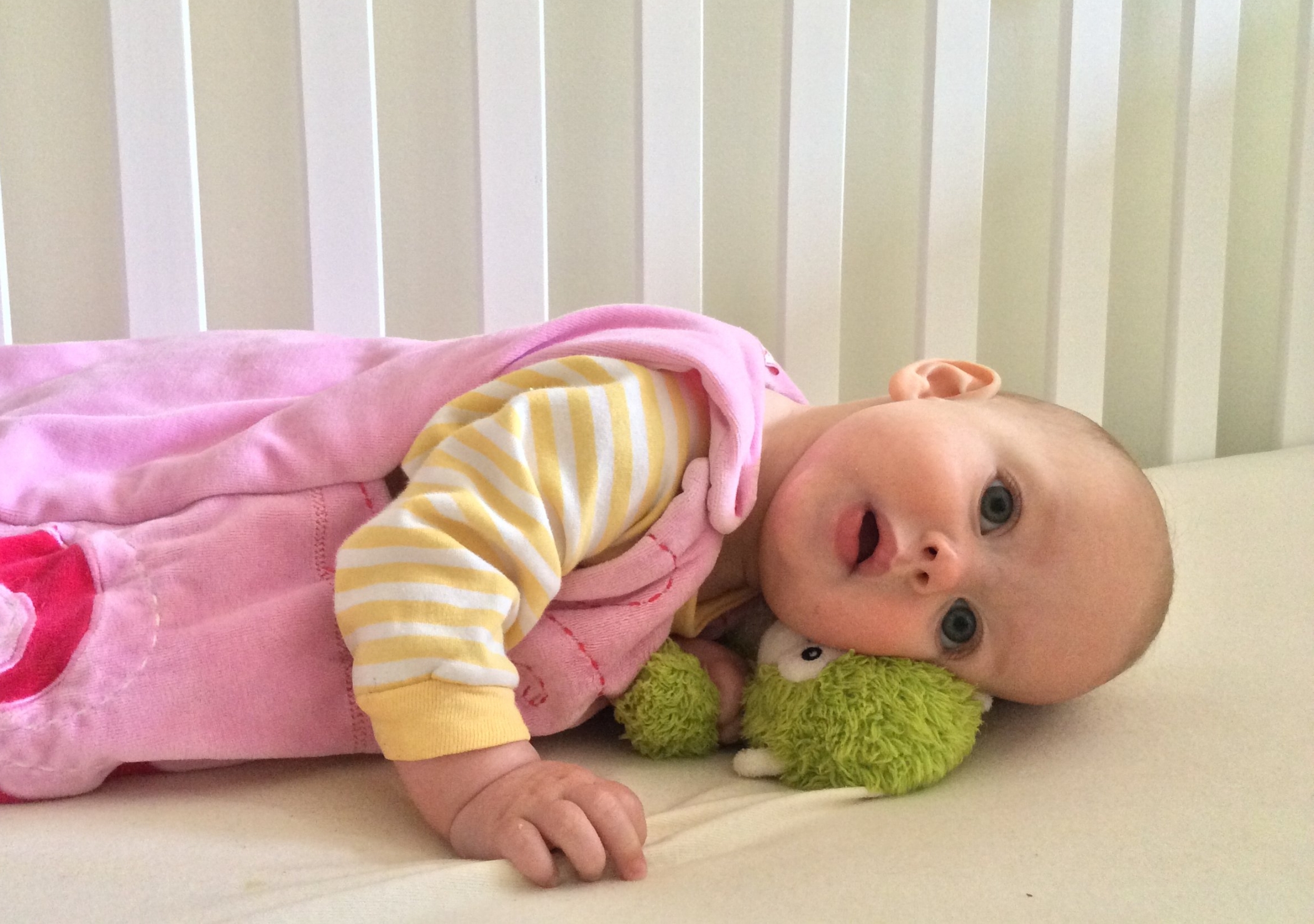
The best room temperature for your baby's sleep is between 18 and 21 degrees celsius.
How hot is too hot for your baby's bedroom? Here's the short answer: anything above 21 degrees celsius. Babies are most comfortable sleeping between 18 and 21 degrees. The rule of thumb to keep them warm is to dress them in one more layer than you feel you need to sleep comfortably.
But what to do in the summer with no air conditioning?
Therein lies the need for the long answer.
One thing is certain: it is safer for baby to be too cold than too hot. Babies will wake and cry if they're a bit chilly, and you can solve the problem then. But they won't likely do the same if they're too hot. And while I don't like to spark fear, especially when the summertime heat is beyond our control, overheating is a risk factor for SIDS (sudden infant death syndrome).
If you're one of those parents whose home is just stifling and you can't seem to cool baby's room, here are some ideas and tips to help keep your baby safe and comfortable:
Dress baby as lightly as possible (see rule of thumb in the first paragraph). Sometimes this could mean nothing but a diaper or just a light, sleeveless sleep sack.
Keep a fan running on high in the room in the hours before bedtime. Turn it to low, direct it away from your baby and keep it far from his reach before you put baby down.
Remove any waterproof mattress coverings while the weather is hot as it doesn't breathe as well.
Invest in good window coverings for baby's room and keep them closed all day with the windows open to prevent the sun from heating the room more.
If your baby falls asleep in the stroller, keep a close eye as she can easily get too warm in there. And don't cover the stroller with a blanket - this can trap more heat inside.
If your baby falls asleep in her carseat, keep the car running and air conditioning on. I know, I know, more greenhouse gasses, more climate change and more hot temperatures. But you have a pretty good reason; all those other idlers should get with the program. (And car seats are for cars - don't let baby sleep in the car seat at home.)
Here's a great idea from Babycenter UK's web site: hang wet towels over chairs and window frames (never over baby's crib railings!) as the evaporating water can cool the air.
Give your baby a cool bath before bed.
If you think your baby may be too hot, feel his belly; if it feels overly warm or he's sweaty, remove a layer; it's worth waking him for. Remember that it's normal for your baby's hands and feet to be cooler than the rest of his body, so don't check there.
While we move through the lazy (or busy!) months of summer, don't forget to keep yourself and your baby well hydrated. For babies under 6 months, breastfeeding to meet demand should be sufficient; just be sure she's having a normal number of wet diapers. If your baby is a little older, offer water from a sippy cup more often than usual.
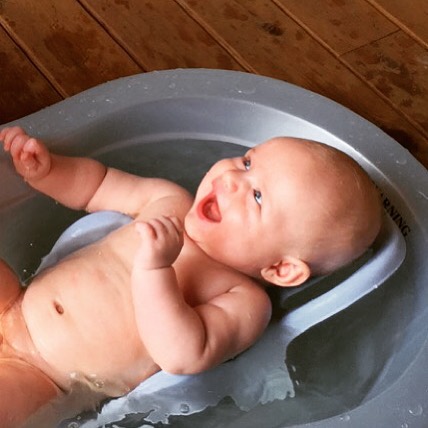
Giving your baby a cool bath before bedtime can help keep him cool for sleep in warm temperatures.